Déclenchement rapide
Every keystroke you already threw away.
A normal key has to travel most of the way back up before it can fire again. This one does not. Here is what that looks like on your own hand.
Press and hold any key. Or press and hold the key below.
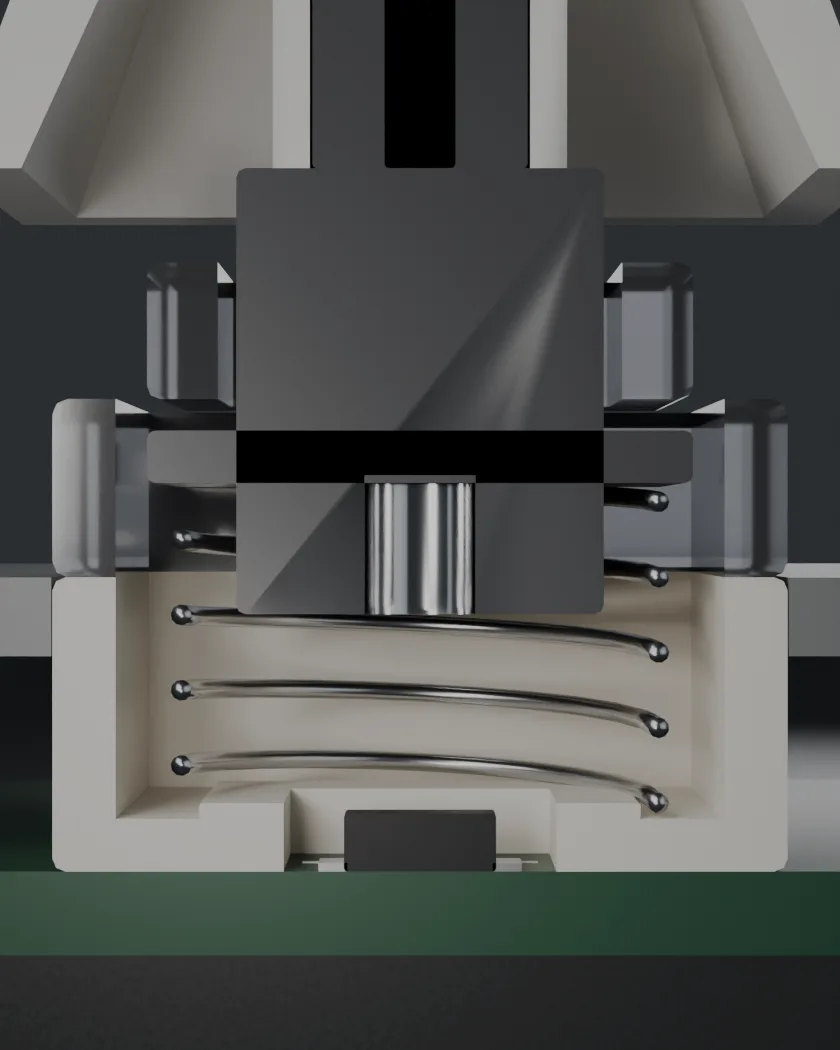
The same switch, rendered at 37 known depths. It follows your finger.
1 · Turn it off, tap fast
Hold the same key down and let it up quickly, several times. With rapid trigger off, a press only counts once the key has come back above the reset point — 0.20 mm above your actuation setting.
2 · Turn it on
Now any change of direction larger than the delta counts, from wherever the key happens to be. The red ticks along the bottom of the scope are the presses that registered.
3 · Move the delta
At 0.02 mm the board answers a tremor. At 1.00 mm it answers only a deliberate movement. Somewhere between those is the number that suits your hand, and it is not the same for everybody.
What it actually does
The firmware keeps two numbers per key: the lowest point the key has reached while rising, and the highest point it has reached while falling. A downward move of more than the press delta from the last local maximum is a press. An upward move of more than the release delta from the last local minimum is a release.
There is no fixed reset point and there is no timer. That is the whole feature.
| Setting | Range | Ships as |
|---|---|---|
| Actuation point | 0.10 – 3.40 mm | 1.20 mm |
| Press delta | 0.02 – 1.00 mm | 0.15 mm |
| Release delta | 0.02 – 1.00 mm | 0.15 mm |
| Rapid trigger | on / off, per key | off |
Why it is off when it arrives
Because it changes how your keyboard behaves, and a keyboard that behaves differently from every other keyboard you have used should do so because you asked it to. Type on it for a week first. Some people turn it on and never turn it off; some people find it answers movements they did not mean.
And what it is not
Rapid trigger is not SOCD resolution. It does not decide anything on your behalf, it does not cancel one key with another, and it cannot produce an input your finger did not make. It only removes the requirement that the key travel back up to a fixed point first.