PALPEUR
The switch is a probe.
A palpeur is the contact stylus of a dial indicator — the part that touches the work and reports where it is. The name is the product description.
Press and hold any key. Or press and hold the key below.
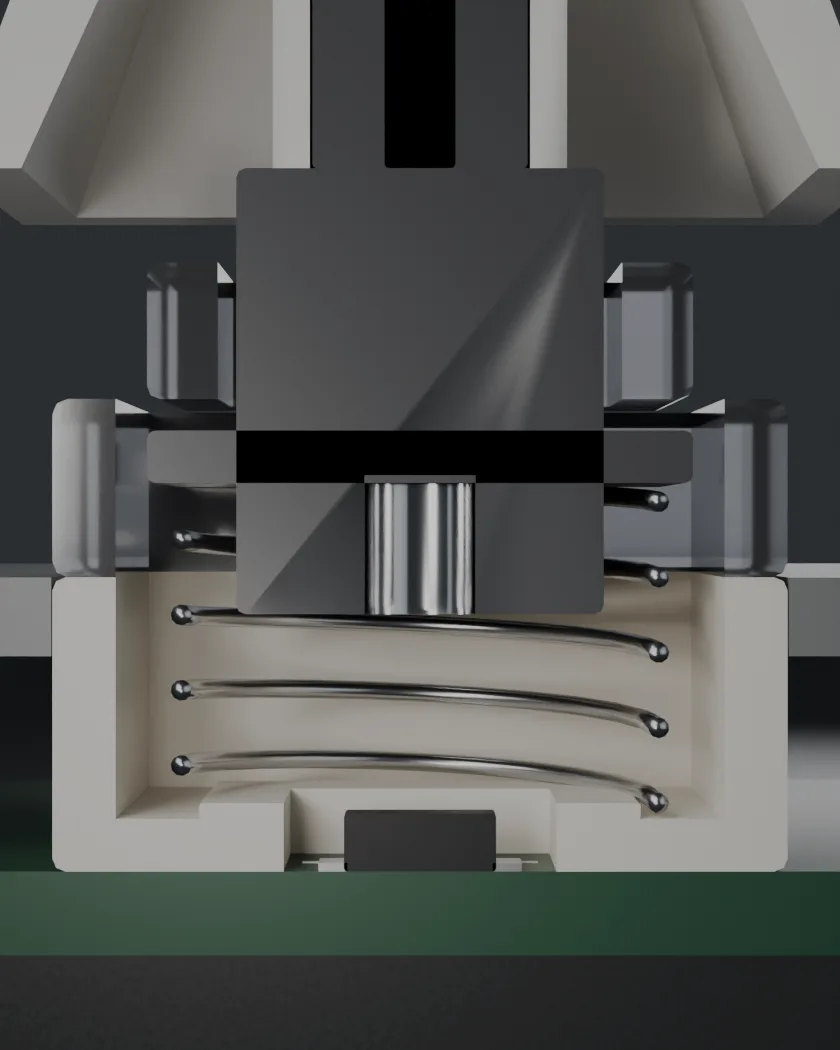
The same switch, rendered at 37 known depths. It follows your finger.
Press a key. The section on the right is the render at that depth; the readings are the field equation at that depth.
What is in there
No contact. A cylindrical neodymium magnet is pressed into the base of the stem; a linear Hall sensor sits under it on the circuit board. There is no leaf, no crosspoint, nothing that closes and nothing that arcs. The only wear surfaces are the stem rails and the spring, which is why the rating is 100 million actuations rather than 50.
| Part | Spec |
|---|---|
| Magnet | ⌀2.0 × 2.5 mm sintered NdFeB, N42, axially magnetised, Ni-plated. Br = 1.32 T at 20 °C |
| Sensor | ENTREFER EF-1c, ±300 mT linear Hall, 14-bit, 8 kHz |
| Stem | POM, self-lubricating, four-point rail, standard cross mount |
| Top housing | Smoked polycarbonate |
| Bottom housing | Nylon PA66 |
| Spring | Stainless, linear, three weights |
| Mount | Five-pin, hot-swappable |
| Rated life | 100 000 000 actuations |
The numbers that matter
| Quantity | At rest | Bottom out |
|---|---|---|
| Depth | 0.00 mm | 3.60 mm |
| Air gap, pole face to die | 4.30 mm | 0.70 mm |
| Flux at the sensor | 10.13 mT | 251.47 mT |
| Sensitivity | 6.1 mT/mm | 256.2 mT/mm |
| Position noise | 13.2 µm | 0.31 µm |
Measured range is 0.10 – 3.40 mm. The ends are excluded on purpose: at 0.10 mm the position noise is already 13.2 µm, and below that the number would be smaller than the thing it is measuring. The whole curve is here.
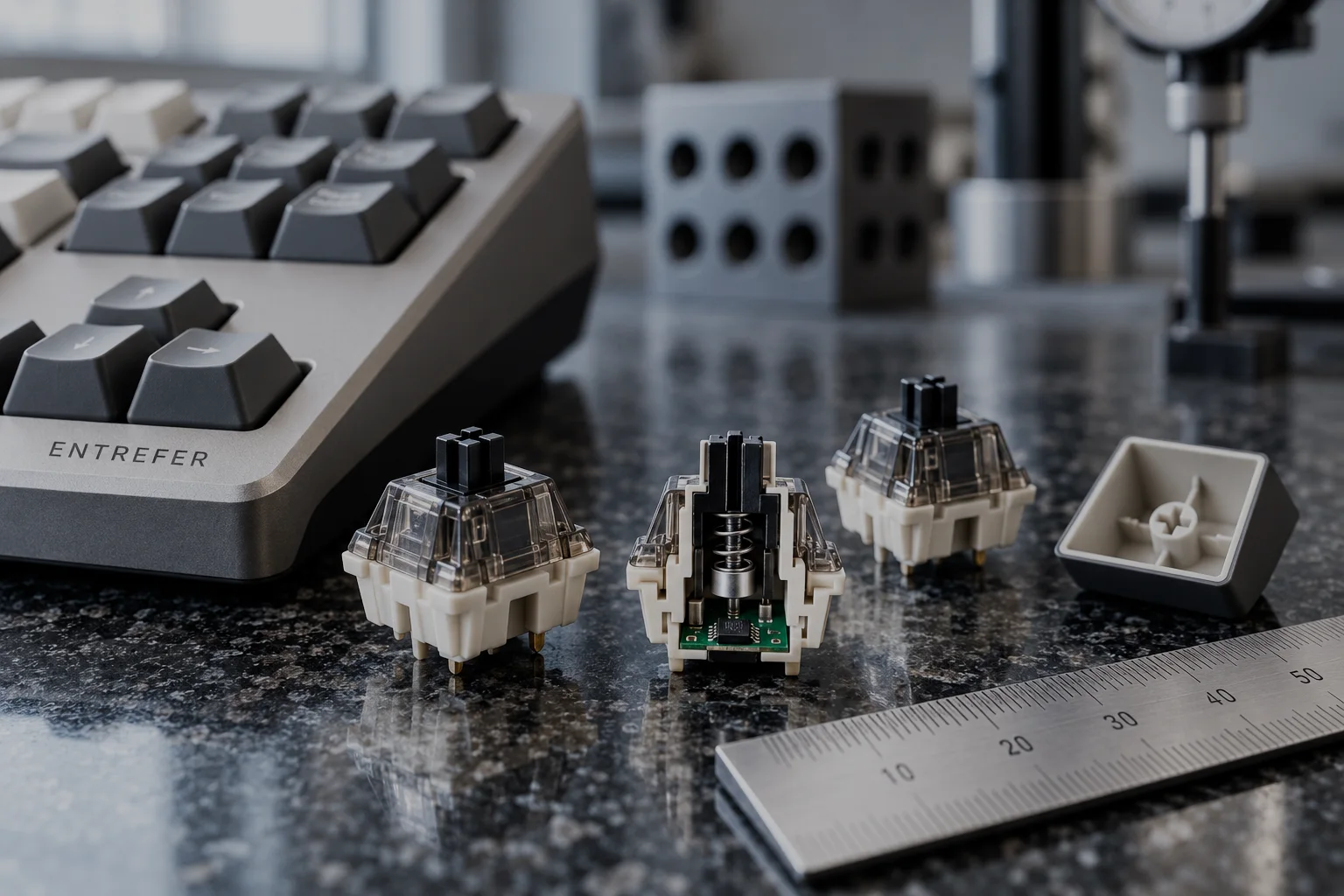
Three weights
Linear, all three.
A tactile bump would be a lie on an analog switch: it tells your finger that something has happened at a fixed depth, when the entire point is that you choose the depth. So the spring is linear and the only decision left is how heavy.
| Model | Initialgf | At 3.40 mmgf | Bottomgf | For |
|---|---|---|---|---|
| PALPEUR L | 30 | 47.0 | 48 | Long typing days, light hands. |
| PALPEUR M | 40 | 62.7 | 64 | The default. Shipped in every board unless you ask. |
| PALPEUR F | 50 | 78.3 | 80 | Heavy hands, and anyone who rests fingers on the home row. |
CHF 39 for forty, CHF 89 for a hundred. Lubed at the factory. We will not sell you a hand-lubed upcharge.
Depth into the key, mm → Drag across the chart.
How the section was made
The switch above is not a photograph and not a drawing. It is one model, cut on its centre plane, rendered thirty-seven times at thirty-seven known depths — 0.10 mm apart — with one camera, one exposure and one set of lights. Only the stem, the magnet, the spring and the keycap move, and they move together because they are parented to a single control.
That is the reason for building the model at all. A still frame is the one thing an image model does more cheaply and often better. What it cannot do is give you the same object at thirty-seven positions, because each frame would be a different switch. The source is in assets-src/blender/palpeur.py and it rebuilds the whole sequence.