Histoire
It started as a sensor.
-
2021
EF-1
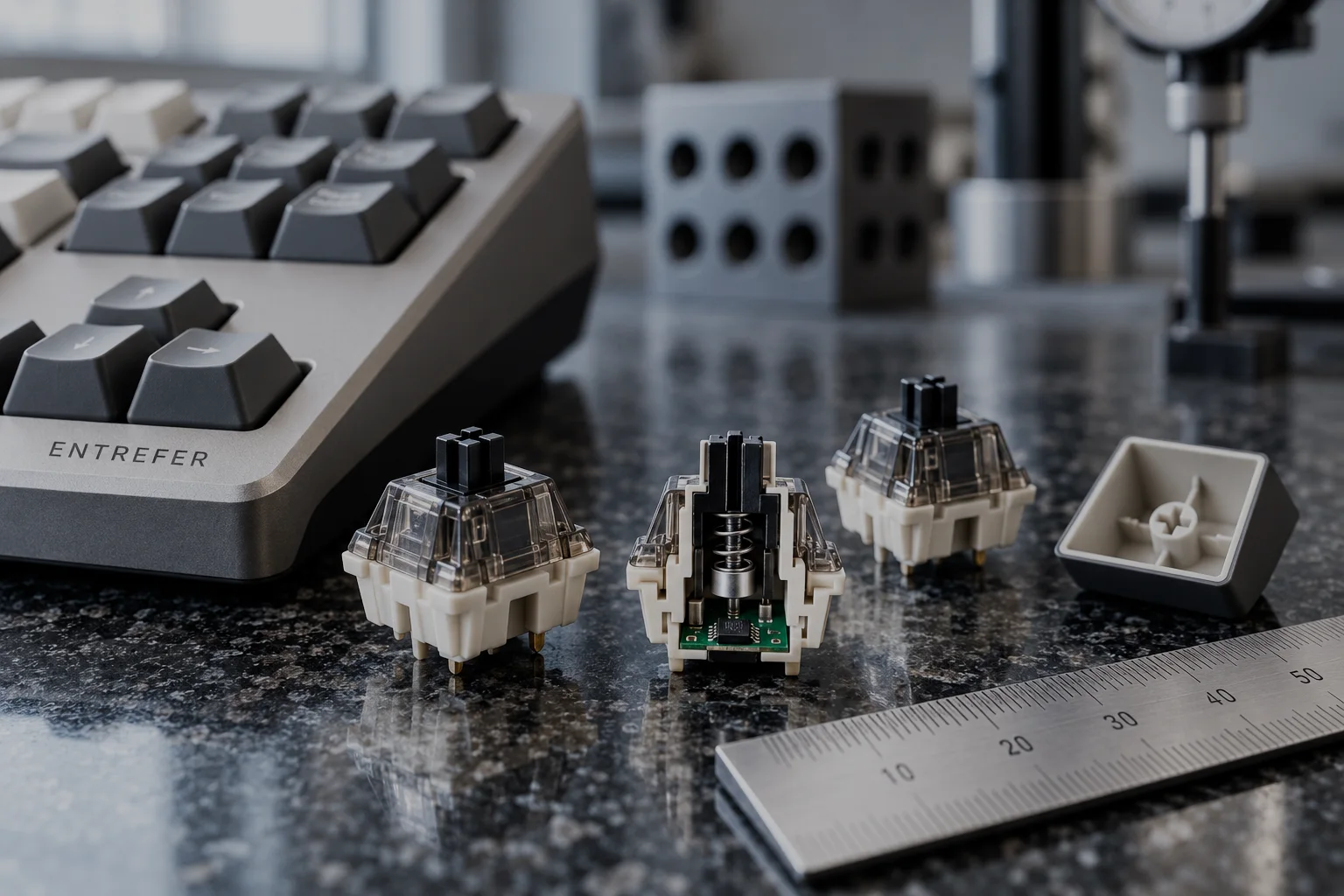
A magnetic linear-position sensor for watch-testing benches, built to measure the lift of a pallet fork — a few tenths of a millimetre — without touching it. Three movement manufactures still buy it.
-
2023
The argument
An EF-1 goes under a keycap to settle a disagreement about how far a key travels before it registers. The answer is 2.0 mm, and nobody in the room can feel where that is.
-
2024
ÉTALON 87
The first keyboard ships in October, with a calibration certificate, because that is what the rest of the business already does.
-
2025
VERNIER 61 and CADRAN 68
The same board in two smaller layouts. Same switch, same sensor, same certificate; one report rate down, because 8 kHz needs the bigger MCU.
-
2026
EF-1c
Fourteen bits instead of twelve, and a noise floor a third of the old one. It is the reason the actuation floor moved from 0.20 mm to 0.10 mm.
The argument, in full
It was about whether you can feel where a key actuates. One of us said obviously yes, you can feel the click. The other said the click is a tactile bump moulded into a piece of plastic and there is no reason at all for it to be at the same depth as the electrical event, and in most switches it is not.
So we put an EF-1 under a keycap, wired a scope to the switch's own contacts, and pressed the key slowly two hundred times. The contact closed at 1.9 to 2.2 mm depending on how fast the press was. The bump was at 1.3 mm. Neither of us could point at the depth where the letter appeared to better than about a millimetre.
That is the whole company. Not that 2.0 mm is wrong — it is a perfectly good place for a key to actuate — but that nobody who types knows where it is, nobody can move it, and the number is a property of a piece of moulded plastic rather than a decision anyone made.
Still true
The sensor business paid for the keyboard business.
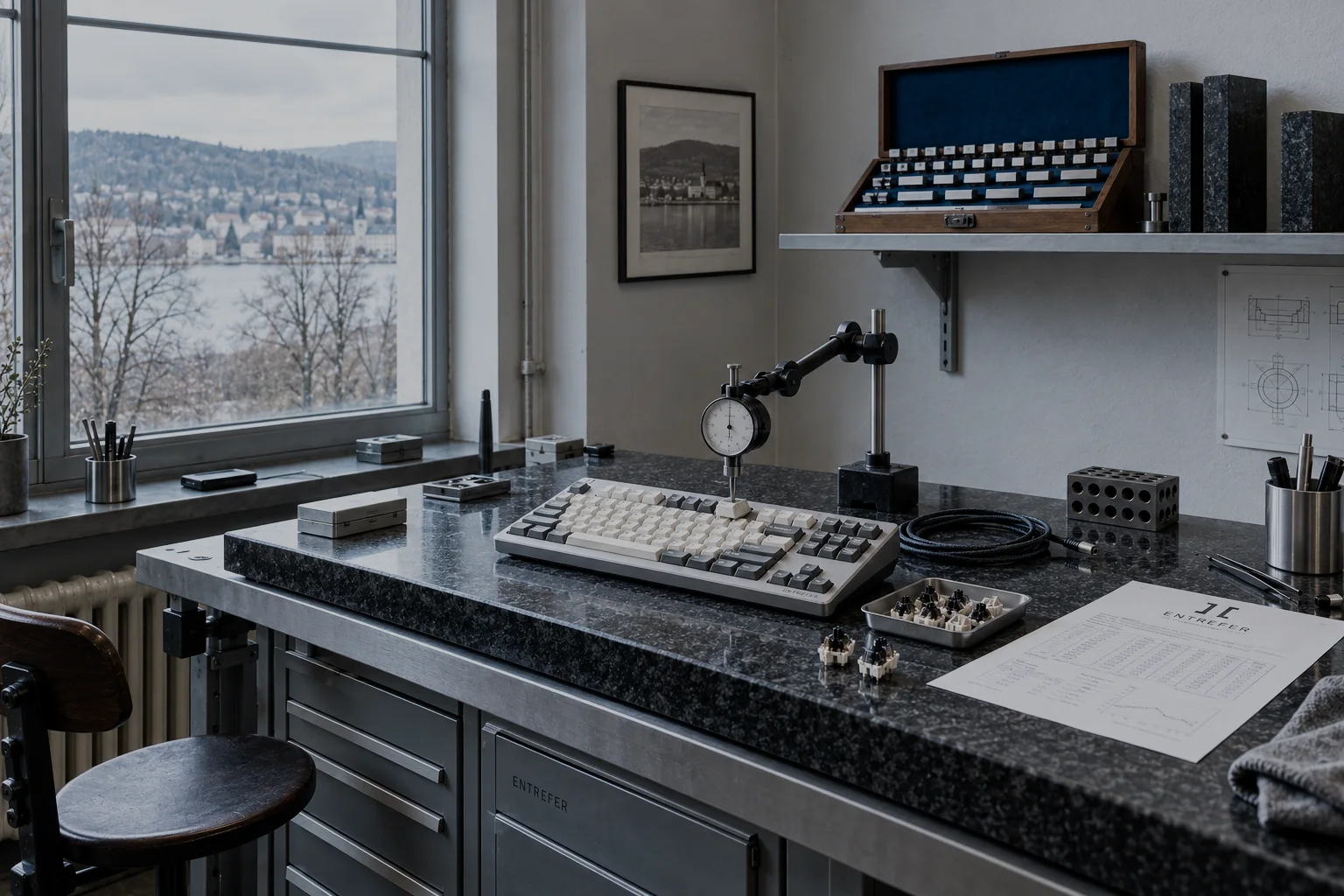
Three movement manufactures in the valley still buy the EF-1, and they are the reason there is a calibration bench in the room at all. The keyboards did not need one; they inherited it — which is why a board that costs CHF 479 leaves with a sheet of paper on it that costs about four minutes.